Conflict between Science and Superstition
I Am LegendThe conflict between science and superstition functions as the intellectual engine of Robert Neville’s struggle with vampirism. At first, the vampire appears to belong wholly to medieval folklore: a creature of darkness repelled by garlic, killed by a wooden stake, and surrounded by rules that seem irrational because they have survived as fragments of legend. Yet Neville’s repeated encounters force him to test those rules, discard some explanations, and connect others to anatomy, infection, psychology, and environmental conditions. The decisive movement is not from false superstition to pure scientific certainty, but from an inherited story to a more exact account of the reality that produced it.
Folklore Against Experience
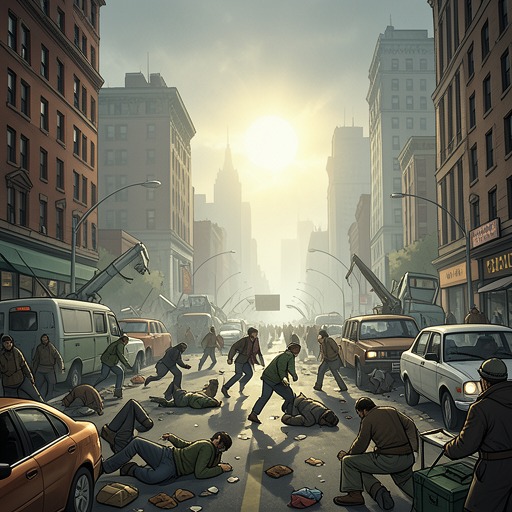
The old vampire tradition initially supplies Neville with a vocabulary when ordinary society has collapsed. The legend’s most important power, as he recognizes while reading Dracula, lies in the fact that people refused to believe in it. The book seems to him a mixture of superstition and melodramatic convention, yet its central insight remains accurate: people cannot fight what they will not acknowledge. Vampires had been treated as obsolete material from medieval belief, literary romance, encyclopedic curiosities, pulp fiction, and B-film fantasies. The plague therefore arrives into a conceptual vacuum. Reality has returned in a form that modern culture has already classified as impossible, allowing the legend to persist precisely because no accepted framework can contain it.
Neville’s early practice is consequently empirical even when his vocabulary is superstitious. He knows that wooden stakes work, but he does not understand why. After a killing, he drives to Sears while wondering why wood alone should be effective and why he repeatedly manages to strike the heart despite having no anatomical knowledge. The questions expose a gap between successful ritual and understood mechanism. A rule can function before its users know its cause; superstition preserves an effect while losing the explanatory chain behind it.
The same uncertainty surrounds garlic. While studying its composition, Neville examines whether water, protein, fat, carbohydrates, fiber, ash, or some other constituent might explain the vampire’s reaction. The odor and flavor of garlic are associated with an essential oil containing allyl sulphide and allyl isothiocyanate, and he begins to suspect that this chemical detail may contain the answer. The object remains an item of folk protection, but his attention shifts from symbolic power to material properties. The traditional remedy becomes a possible experiment.
Observation, Error, and Revision
Neville’s reasoning advances through sharp observations but also through delayed connections and mistaken assumptions. The clearest breakthrough comes when he finds a dead vampire whose body changes rapidly in daylight. The heart has not been touched, and garlic has not been used, yet something has killed it with brutal efficiency. He realizes that sunlight is the missing cause, then condemns himself for failing to connect the vampires’ nightly activity with their disappearance indoors during the day. The discovery transforms a seemingly supernatural vulnerability into an environmental one, but it also reveals how confirmation and habit have limited his investigations for five months.
His later work proceeds by allowing contradictory evidence to remain active instead of forcing every phenomenon into one theory. After encountering the idea of hysterical blindness, he adopts a new approach. He had previously attributed all vampire phenomena to the germ and treated whatever did not fit the bacilli as superstition. Now he considers that some effects may be physical while others are psychological. The distinction matters because it prevents science from becoming another rigid creed. Neville’s earlier rejection of psychological explanations was not ignorance alone; it was a form of preconception that made the entire problem easier to classify and harder to understand.
The same corrective appears in his response to the medical evidence surrounding insects and disease. A mosquito troubles Virginia, who observes that mosquitoes, flies, and sand fleas carry diseases and that Kathy’s bed should be protected by a net. Later, Neville reads that many bacterial diseases can be disseminated mechanically by flies and mosquitoes. These details connect domestic anxiety with epidemiological reasoning. The insect is not merely an unpleasant household presence: it becomes part of a transmission network that helps explain how the plague could spread with a speed that nightly vampire attacks alone could not account for.
From Vampire to Bacillus
The central scientific reversal begins when Neville permits germs to become a serious hypothesis. He has resisted the idea because it seems too immense and because the word itself carries none of the dramatic force of the vampire legend. Eventually he recognizes that bacteria could be the answer to the vampire and allows reason to replace the iron boundaries of his earlier theory. The plague’s speed, the relation between blood and illness, and the possibility of mechanical transmission all become compatible within a germ-based model.
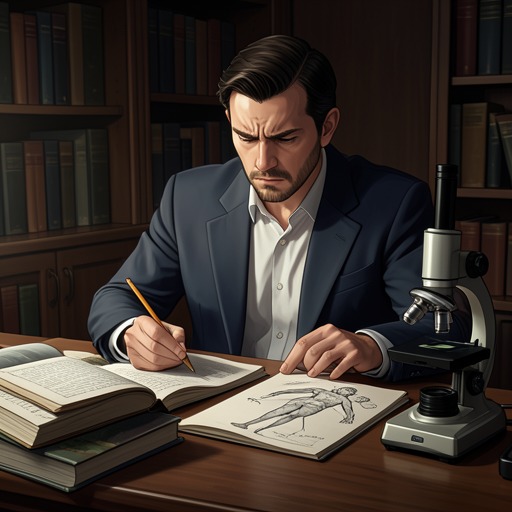
His investigation reaches its most concrete point under the microscope. After days of difficulty mounting and centering blood samples, Neville examines his thirty-seventh slide. The organism is visible, so it cannot be a virus. He identifies a germ and names it Vampiris. Consulting bacteriology texts, he classifies it as a bacillus: a cylindrical rod of protoplasm that moves through blood by means of flagella projecting from its cell envelope. The microscope does more than provide a medical fact. It collapses centuries of fearful superstition into a visible object and gives Neville a causal entity where legend had supplied only ritual, genealogy, and fear.
The subsequent model removes the supernatural without denying the vampire’s reality. Spores can be released and carried by storms, lodge in tiny abrasions produced by scaling dust, germinate in the skin, and multiply by fission. As tissues are destroyed and channels become obstructed by bacilli, poisonous decomposed substances enter surrounding tissue and eventually reach the bloodstream. The resulting process requires no bats fluttering against estate windows, no blood-eyed creatures hovering over sleeping heroines, and no supernatural agency. Yet the conclusion is not that the vampire was imaginary. The vampire was real; its true story had simply never been told. Science therefore corrects the legend by explaining it rather than by erasing the experience that generated it.
The Limits of Simplification
Scientific explanation also changes the meaning of individual vampire traits. Experiments show that the bacilli produce a powerful body glue that seals bullet openings almost as soon as they are made. Bullets become enclosed, penetration is limited to a fraction of an inch, and the infected body can contain an almost indefinite number of projectiles. What looks like supernatural immunity is instead a biological defense activated by germs. Shooting vampires is ineffective not because an occult law protects them, but because their altered physiology neutralizes the weapon.
At the same time, the scientific model does not make every inherited feature equally simple. Neville’s acceptance that some phenomena may be psychological leaves room for the mind’s role in producing or sustaining effects that infection alone cannot account for. The legend is therefore dismantled in layers: sunlight, garlic, blood, bullet resistance, and other traits can be investigated as physical or biological events, while responses shaped by trauma, belief, and expectation require a different explanatory register. A scientific account becomes stronger when it distinguishes mechanisms instead of treating every mystery as evidence for one universal cause.
The dog’s appearance tests this distinction through an emotionally charged natural experiment. A weakened, limping dog roams outside in daylight, frightening Robert Neville when it flees from his porch. He leaves milk and hamburger surrounded by garlic bulbs, then realizes that the garlic may repel the dog even if its infection is slight. When the animal finally approaches, Neville waits motionless and seizes it, restraining its snapping jaws while it whines in terror. The scene makes the dog simultaneously a possible carrier, a vulnerable living subject, and the focus of Neville’s responsibility. Scientific speculation cannot protect him from the ethical consequences of being wrong.
Significance of the Conflict
The conflict between science and superstition gives the novel its governing irony. Neville is surrounded by phenomena that earlier generations interpreted through myth, yet he must use damaged books, imperfect instruments, bodily evidence, and repeated observation to recover the mechanisms beneath that myth. His progress depends on skepticism, but also on respecting the observations embedded in traditions he initially regards as crude. The wooden stake and garlic are not vindicated as magical objects; they become clues whose effectiveness demands explanation.
This method also exposes the danger of treating scientific reason as a new form of certainty. Neville repeatedly reaches conclusions, discovers exceptions, and revises his assumptions. He first lets the germ explain too much, then admits psychological causes; he recognizes sunlight only after overlooking an obvious pattern; he moves from ritual practice toward chemistry and microbiology without pretending that the transition is effortless. Knowledge emerges through correction, not through the possession of an untouched rational viewpoint.
Most importantly, the scientific account alters the moral and historical position of the vampire. Once vampirism is understood as infection and altered physiology, the creature is no longer merely an enemy from superstition’s past. It belongs to a biological history that includes insects, blood, disease, immunity, and adaptation. The old legend had named the visible terror but not its cause. Robert Neville’s investigation supplies that cause, while the surrounding narrative shows that explanatory victory does not restore the lost world. Science can reveal what the vampire is; it cannot by itself decide who counts as normal, who is monstrous, or what society will do with the person who understands the new reality first.